Social emotional education is a topic that I am deeply passionate about. As educators, it’s our privilege and duty to dedicate ourselves to nurturing the social and emotional growth of every child in our classroom. These skills are essential not just for the classroom, but for life. We have the unique opportunity to support our students as they learn to navigate their emotions, feelings, and behaviors effectively. In this post, I’ll share exciting ideas and strategies to incorporate this vital aspect into your classroom. Not only will these critical skills be developed, but everyone will also have fun learning and growing together!

The Why
Social emotional education is more than just a buzzword; it’s a game-changer in the classroom! These skills are crucial for helping students thrive not only academically but also personally and socially. When kids understand how to manage their emotions, build healthy relationships, and make responsible decisions, they become more engaged and ready to learn. Plus, fostering a supportive, empathetic classroom environment sets the foundation for a positive school experience and lifelong success. Let’s make learning not just about facts and figures, but about growing kind, resilient, and emotionally intelligent individuals.
In this post, we’ll explore fantastic ways to seamlessly integrate social emotional learning into your school day. We’ll focus on building a strong sense of community, using literature to spark meaningful discussions, and creating a calm-down area for those moments when emotions get too big. Plus, I’ll share some awesome resources to help you every step of the way. Get ready to transform your classroom into a nurturing space where every student can flourish emotionally and academically!
Social Emotional Education Starts with Community
First thing to do is spend time building a loving community with your class. Just like we teach and model expectations, we must also teach and EXPLICITLY model behavior as well. Of course we must teach them how to express themselves and show kindness to everyone. I am a HUGE proponent of explicit modeling for students. I believe that no matter the skill students are being taught, we must model for them what it looks like and what it sounds like. In order to do that, we must think through what we need to model.
Think about how we communicate, how we calm ourselves when upset, how we work together, etc. While teaching, I model A LOT and then provide opportunities for them to practice what we’ve learned. We must allow ample practice time for students to work through these skills in order for them to become successful at doing it. I also like to show students what it doesn’t look like so that they see when they need to redirect. Always remember, while students are practicing what it looks like, they get to watch YOU practicing what it doesn’t look like. They love watching you make mistakes or be silly and really love to correct you. However, you NEVER want students to practice what it doesn’t look like. We want them only displaying the modeled correct behavior! Check out even more ways to crush teaching students any expectation with this post HERE!

Using Literature for Social Emotional Education
I LOVE using literature to teach different social emotional skills and topics to students. There are so many wonderful books to help students relate to and understand big and heavy topics in a safe way. Read alouds allow us to facilitate great conversations, discuss misconceptions, and open up for so many other companion activities to help practice skills. There are SO many amazing Social Emotional books out there and the list just keeps growing and growing! Usually, Google and social media platforms are some of my favorite ways to learn about and find new books. Take a look at this POST that includes some of my favorite SEL books and what great topics they cover!
Expressing Yourself
When it comes to social emotional education, communication is number one. Expressing yourself is a super important skill when it comes to social and emotional well-being and we’re not born knowing how to do it in an effective and respectful way. I want you to think about your students again and their background. Do they know how to effectively communicate? Have they ever been taught how to express themselves? Do they have the language to do it effectively? Maybe. However, some adults are still learning how to do this, so we of course have to teach the littles our expectations. As with every other expectation, we must MODEL and PRACTICE over and over again.
One of my favorite ways to teach young learners how to express themselves to let someone know that something has upset them is by reading, A Bug and a Wish by Karen Scheuer. This book is a great way to introduce the concept of speaking up. It teaches a very simple and effective way to say, “Hey. I don’t like that. Please fix it.” Check out the poster that I love using below. It provides students with the language they need so that they can begin to express themselves in a respectful way.

Problem Solving Pack
Introducing I Statements is another great tool for students to use while communicating how they feel. Here’s an example, “I feel sad when you say things about my shoes. I want you to stop doing that.” Or “I feel angry when you don’t include me. I want to play together.” These respectful, direct statements help students express how they feel and state what they want. Anchor charts are a great way to give students a constant reference when learning how to express themselves. I keep our behavior charts up the entire year for students to refer back to when expressing themselves and solving problems. Providing students with sentence stems scaffolds learning and helps to build the capacity to learn how to express feelings independently.
One activity I love using at the beginning of the year is Emotions Uno. It is a fun way for students to begin learning how to express themselves and know that they are in a safe environment to share their feelings.


Social Emotional Education Solves Problems
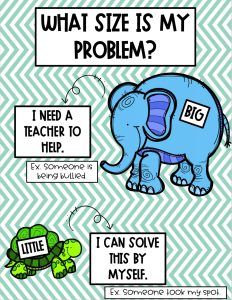
We need effective communicators so that we can solve problems. The goal is to teach students to know how to solve problems independently, or at least attempt to do before seeking help from an adult, or having a meltdown. At the beginning of each year we learn about Big and Little Problems and the difference between the two. Then we learn ways to independently solve our little problems. If you’ve taught primary students you know exactly how exhausting it can be to help solve ALL those little problems throughout the day- “She’s looking at me.” “I lost my pencil.” “My crayon broke.” The list goes ON and ON. Instead, use this lesson HERE so students can learn to be independent problem solvers! After subscribing, you will have EXCLUSIVE access to the Size of the Problem DIGITAL Sort pictured below, as well as my entire FREEBIE resource library!


Team Building
In class we have to solve problems together. But of course we have to teach expectations for how we work together. How are we a team? What does that look and sound like? There are some WONDERFUL books that we can use to learn why it’s important to be a team. One of my favorites to use is, Teamwork Isn’t My Thing and I Don’t Like to Share. We read this book together and discuss the importance of teamwork and why we are a team. Then comes the fun part, team building activities! Below you can see just a few of my favorites, such as cup stacking, a worm and a lifesaver, the hula hoop challenge, and more! Read all about them in 15 Must Know Team Building Activities !


Apologizing
Knowing when and how to apologize in a meaningful way is a crucial communication skill that must be explicitly taught. How many times have you encountered a kid mumbling, “sorry.”? This is where we step in by teaching them what it looks and sounds like to apologize. I like to use this poster to help students effectively apologize in a way that matters. Then, we MODEL and PRACTICE. We must create a safe space for students to express themselves and we do that by setting expectations for peers to communicate, problem solve and apologize when they’re wrong. We must teach them how to do these things and why it matters. Take the time to act out scenarios and role-play. If you spend ample time at the beginning of the year, you will be amazed at how students are able to effectively communicate and solve their problems.

Morning Meetings
These gatherings are the perfect way to kickstart your day! Morning Meetings can help you gauge how students are doing each day, have important discussions about social and emotional skills, reminders of expectations and goals, or just to talk about the exciting things you’ll learn that day. There are tons of different prompts out there for you to have deep and meaningful conversations. They don’t need to be long and it’s a great way to continue to strengthen your community. Morning Meeting Book is a wonderful resource to learn more about the impact of these gatherings. Read more about morning meetings, connection circles, AND restorative circles HERE!
Social Emotional Education and Calming Strategies
Even when we know how to express ourselves, sometimes our feelings are too big for the moment. What happens when our students are SO upset that we are not ready to learn? How can we teach them to handle our big emotions in a safe way? Two words: Chill Zone. It could also be called the Peace Place, Calm Down Corner, etc. No matter what you call it, this is a designated space students can go and learn how to manage their feelings.
When introducing the space to students, I love reading Howard B. Wigglebottom Learns It’s Ok to Back Away and Little Monkey Calms Down. Both books are great for learning to understand when our bodies are tense. After reading, we create a Signs of Tension Anchor Chart, discussing that when our body feels this way, we need to use strategies to regulate our bodies. Check it out below!

Our “Chill Zone” is also equipped with different calming tools that can be used. Just like everything else in our classroom, how to use this zone should EXPLICITLY taught and modeled. We also must learn how to time ourselves and how much time we spend calming. And of course we PRACTICE, PRACTICE, PRACTICE. One thing to note here is that this space is NOT a time out or punishment. This area is a tool for self-regulation so students learn to recognize when they need to calm down. Of course as teachers we can help students recognize if they are upset, but we do not force students to use this place. If ample time is spent practicing and modeling, this space becomes a very effective way for students to learn how to manage their own big emotions. I love this Calm Down Spot kit found HERE!


Growth Mindset
Learning to express yourself, apologize, and calm down are all really tough skills when it comes to social emotional learning. Having a growth mindset ensures that we’re confident enough to pick yourself up and try again if you get it wrong the first time. There are ENDLESS books that cover having a growth mindset that really helps students connect and understand what it means to have one. In addition to great literature, one of my FAVORITE tools to teach growth mindset is with The Class Dojo mini series! These are 5 short videos that can be watched over a week’s time that can lead to some great discussions about having a growth mindset.

I also love using this anchor chart pictured below that goes great with lessons about goal setting! The two topics really go hand in hand and help students recognize that we are ALWAYS learning and growing. My favorite is when students start to learn about having a fixed vs growth mindset, and start to recognize it in themselves or each other! Teaching students this vocabulary, while creating a supporting environment, can really help students grow in their social and emotional health. It allows them to push themselves and others to continue to get better. It is truly a beautiful, magical thing that can be created in your classroom.


Social Emotional Check Ins
Simple mental health check-ins are an easy way to gauge where your students are at emotionally and can help you plan how to address feelings that need support. Maslow must always come before Bloom. If students aren’t having their basic needs met, how on Earth could we expect them to be ready to learn? Check-ins can be conducted at the beginning and/or end of the day and can be as simple as having students mark their feelings on an emotion board. Keeping it simple and consistent is what will make a huge impact. They’ll know you always keep their wellbeing at the forefront.
If you have a student who is really struggling, check-ins could be required more often. Sometimes you might also need outside resources to check in. Maybe your student doesn’t feel comfortable with you yet or maybe they have a really strong connection with another adult in the building. Collaborate for the sake of your student’s mental health. Direct them to a trusted individual so they can feel safe and supported. As educators we know that we are ALWAYS better together. USE your resources. Reach out to colleagues to give a helping hand with students who are really struggling or ask them to help you if you’re ever struggling to make a connection with a particular kid. Help foster those other relationships and help your students be comfortable sharing their feelings with someone, even if it’s not you.
Other Social Emotional Resources
If you want to implement these strategies but save yourself a lot of work, check out this JAM PACKED social emotional learning GROWING bundle. This means you’ll get everything for FREE whenever we add something! Grab it below!!

Social Emotional Growing Bundle
I really hope you enjoyed learning more about social emotional education! Stuck on planning and want help? Got specific questions for your classroom? Drop them in the comments below and we’ll be glad to help answer them! Don’t forget to subscribe to my email list! Not only will you get the most up to date tips, tricks, and classroom projects… and of course more fun FREEBIES including the Digital Size of the Problem Sort FREEBIE! You will also have exclusive access to tons of digital how-to videos! If you would like to learn about this and other things happening in my classroom follow me @sweetnsauerfirsties on Instagram.
To follow me on TPT and get all the latest updates on HALF OFF new products, click HERE!

Love these ideas but don’t want to lose them? Don’t forget it, PIN it below!
Spread the Love

Leave a Reply